Which Time Zone Is the Grand Canyon In? Season Guide + Tips

“What time is it in Arizona?” It’s a simple question with a not-so-simple answer, depending on what time of year and what part of Arizona you’re visiting. The Arizona time zone confuses some because the state doesn’t adhere to Daylight Saving Time.

If you’re trying to schedule travel plans or an itinerary for a Grand Canyon wedding, we’re here to make “Arizona Time” easier to understand.

We found this topic especially important since many online articles about Arizona’s time zone were more confusing than helpful. Read on to find out everything you need to know about Arizona’s unique time zone.

NOTE: For ease of reading this article, Standard Time references will be referred to as “winter,” while Daylight Time will be listed as “summer.”


Why Doesn’t Arizona Follow Daylight Saving Time?

To answer that question, it helps to know the purpose of the time change. Time zones were established by railroads in the late 1880s, and every state was on Standard Time.

The idea of moving ahead one hour in the spring came from the energy-saving cost benefits during wartime in the early 1900s. It then transitioned to the benefit of having an extra hour of daylight in the evening during the warmer spring and summer months.

The Uniform Time Act of 1966 established a fixed schedule of Daylight Saving Time at the federal level. Since then, Daylight Saving Time has started on the second Sunday in March and ends on the first Sunday in November–always on a weekend and always at 2am local time. In March, all clocks move forward one hour. In November, clocks “fall back” an hour.

Arizona wasn’t happy with Daylight Saving Time from the start. Simply put, Arizona leaders believed the state already had enough heat and sun in the summer. Plus, adding an hour would increase energy consumption and costs for air conditioning.

Plus, consider that even without Daylight Saving Time, August temperatures at the bottom of the Grand Canyon reach 106° F on average and reach 110° F in Yuma. Another hour of summer sunshine wasn’t necessary or desired.

Is Daylight Saving Time Optional? Under the Uniform Time Act of 1966, states have the option to exempt themselves from DST by passing a state law or regulation. Arizona, along with Hawaii, has chosen not to observe it.

Not ALL of Arizona Skips Daylight Saving Time

The only exception to Daylight Saving Time in Arizona is the Navajo Nation, a sovereign nation with a footprint that is largely in northeastern Arizona but also expands to Utah and New Mexico.

The decision to adopt Daylight Saving Time in the Navajo Nation keeps the multi-state land in the same time zone year-round.

However, there are more exceptions within that exception. Keep reading for specific examples.


How Does Daylight Saving Time Impact Arizona?

At the root of Arizona time zone comprehension is understanding that half the year, Arizona is in tandem with the Mountain Time Zone. The other half of the year syncs with the Pacific Time Zone.

When visitors outside the state make travel arrangements, things can get tricky. This is also where many sources make it overly confusing.

Arizona is always in Mountain Standard Time, which is not the same as saying Arizona is always in the Mountain Time Zone.

Arizona is always in Mountain Standard Time, which is not the same as saying Arizona is always in the Mountain Time Zone. Mountain Standard Time is always UTC-7. (UTC, or Universal Time Coordinated, serves as the time zone baseline from which all other time zones are calculated. Here’s an easy UTC clock.)

In winter, Arizona is on Standard Time (UTC-7). When other states “spring forward” in March, that means they are on Daylight Time. Utah goes from Mountain Standard Time to Mountain Daylight Time for summer, which is UTC-6. Since Arizona doesn’t change, it’s still at UTC-7. Technically, it’s still on Mountain Standard Time.

It’s the “Mountain Standard Time” year-round part that confuses some because flights, weddings, and attractions aren’t booked with that caveat in mind. They are booked based on Pacific Time and Mountain Time in mind, whether it’s summer or winter (Daylight or Standard).

Now, to further understand, it’s important to note that Pacific Standard Time is UTC-8, but when Daylight Saving Time kicks in, the one-hour leap puts it at UTC-7, which is the same as Arizona. In summer, it’s most commonly understood that Arizona is on Pacific Daylight Time since they are both UTC-7.

Arizona technically sticks to Standard Time year-round. It’s just easier to say, “Arizona is in the Pacific Time Zone in the summer.”

Harun Mehmedinovic grand canyon wedding packages destination weddings USA

Examples of Arizona’s Time Zone Travel Impact

The concept becomes easier to understand when you look at real-life examples of how this transition can impact a trip to the Grand Canyon for a wedding or elopement.

Driving from Las Vegas to the Grand Canyon

If you’re flying into Las Vegas (LAS) for the drive to the Grand Canyon’s South Rim in summer, the route is 280 miles and will take about four hours and 15 minutes. Nevada and Arizona will be in the same time zone. If you leave Las Vegas at noon, you’ll arrive at Grand Canyon Village around 4:15pm.

Leaving LAS on a winter day still takes about 4:15 drive time. The difference is that LAS will be on Pacific Standard Time. When you cross into Arizona, you’ll be on Mountain Standard Time, meaning the clocks move ahead an hour. That same drive has an arrival time of 5:15pm, even though you’ve driven the same distance.

On the return trip, driving from the Grand Canyon to LAS means you leave at noon, making the four-hour 15-minute drive, but you’ll go back an hour when you cross into Nevada. That means instead of arriving at 4:15pm, you’ll arrive at 3:15pm during winter.


Flying Between Time Zones to Arizona

Those flying into Phoenix might notice something odd when booking flight times from different time zones. Let’s look at Denver as an example.

Denver and Phoenix are both in Mountain Standard Time in winter. The flight between the two cities takes roughly two hours. A noon flight out of DEN in winter will get you to PHX at 2pm.

That same flight that leaves at noon in summer will have an arrival time of around 1pm since you “gained an hour” flying from Denver’s Mountain Time zone to Arizona’s alignment with Pacific Daylight Time.

On the other hand, flying from Los Angeles is always a 90-minute flight. However, in winter, a 7am flight gets you into Phoenix at 9:30am. That’s due to 90 minutes of flight plus the hour gained when moving between Pacific Standard Time and Mountain Standard Time.

In summer, the 7am flight lands at 8:30 am since both L.A. and Phoenix are in sync with Pacific Daylight Time.


Arizona Time Zone Easy Calendar

Visiting Antelope Canyon, Glen Canyon, or Monument Valley

As noted above, the Navajo Nation adheres to Daylight Saving Time. When planning things to do during your Grand Canyon wedding trip, you’ll run into places that are in Utah or within the boundaries of the Navajo Nation.

Again, in winter, Arizona, Utah, and the Navajo Nation are in the Mountain Time Zone. Planning times aren’t a challenge. However, summer is where things get confusing when Utah is one hour ahead of Arizona.

Here’s why:

  • Glen Canyon National Recreation Area: While most of the NRA and Lake Powell are in Utah, the headquarters is in Arizona. That means the entire NRA is at the same time as the Grand Canyon, no matter what.
  • Antelope Canyon: While this stunning slot canyon wonderland is on the Navajo Nation, it is an exception to the Daylight Saving Time rule. Since tours are required to explore the canyons, organizers found it easier to keep those on Arizona Time.
  • Vermilion Cliffs National Monument: Depends on where you are within the monument, but all permit system times are based on the Utah/Navajo Nation. In-person activities and hikes will follow the time zone of the state you are in.
  • Monument Valley: This spectacular scenic drive straddles Utah and Arizona but is within the Navajo Nation. Daylight Saving Time applies. It will always be in the same time zone as Salt Lake City.
Vermilion Cliffs The Wave Coyote Butte North Arizona

Adjusting Your Phone for Arizona Time

Whether the Grand Canyon wedding couple or members of the wedding party want to explore beyond the Grand Canyon, it’s important to know that mobile phones don’t understand these complex rules.

Your phone and vehicle clock will change with the firm boundaries controlled by GPS. This is where location tracking for clocks can cause additional problems since you’ll never be 100% sure if the time is correct. But there is a solution.


Sunrise and Sunset Times at Grand Canyon’s South Rim

We know many couples want to have a sunset wedding or photo shoot, and you can plan around that time of day. It’s just as important to prepare for the Grand Canyon South Rim weather as it is for the sun angle.

While the days get longer or shorter with the seasonal transitions, the lack of adjusting an hour forward or back for Daylight Saving Time gives a more consistent time frame for sunset viewing and photos.

On the shortest day of the year, December 20, days last about nine hours and 45 minutes. Sunrise happens at 7:30am, and sunset is 5:15pm. On the longest day of the year, July 20, expect 14 hours of daylight, with the sunrise at 5:27am and sunset at 7:42pm.

That means Grand Canyon sunsets at the South Rim will always be somewhere between 5:15pm and 7:42pm.

MORE: Full list of sunrise, sunset, moonrise, and moonset times from Grand Canyon National Park


Take Time to Explore Grand Canyon Elopement Possibilities

We wrote this article to help clear confusion, not create it. At the same time, it is always helpful to confirm with a vendor which time zone transition they adhere to in the summer.

You can also contact us with questions or to start planning a wedding, elopement, or proposal.


Pin Arizona Daylight Saving Time Explainer

6 Best Grand Canyon National Park Wedding Locations

grand canyon wedding package lipan point

Few national parks are as accommodating as Grand Canyon National Park for weddings and elopements. While you can’t go wrong with any of the 6 top locations for a Grand Canyon wedding, each spot brings something special. 

To help you prepare for a wedding at the Grand Canyon, we want to share our insight after decades of planning events on the South Rim. Be sure to pair this with our Grand Canyon Month-by-Month Weather Wedding Guide to help find the right time of year and spot for your special day. 


Shoshone Point

Elevation: 7,300”

Special Use Permit Fee: $280

Shoshone Point brings a trifecta of wonderful wedding benefits. First, it’s a secluded spot that can be reserved for your Grand Canyon wedding party, no more than 30 minutes from Grand Canyon Village. While other sites have a two-hour time limit, the limit is six hours here. 

Second, the views are great from the picnic area or on Shoshone Point, which is also home to Shoshone Rock, a unique formation and photo op. Finally, it’s the only wedding site location at the rim that allows receptions. Up to 85 people are allowed, including all guests and staff.

The ramada, picnic area, and restroom facilities are at the end of a mile-long dirt road, which does require an SUV or high clearance vehicle. Aside from the occasional hikers, this area offers privacy and space. The only things to consider are the fact that it’s only available from May 15 through October 15, and the vertigo-inducing point might be a bit overwhelming for some guests. Parking at the site is limited to 5 vehicles and our staff will need 2 of those. Additional parking is available at the end of the dirt road at the gate and guests can carpool up the road from there.

MORE: Shoshone Point Photo Gallery


Grandeur Point

Elevation: 7,050’

Special Use Permit Fee: $280

Grandeur Point is one of the closest approved wedding spots to Grand Canyon Village, with an easy walk on the paved Trail of Time. It shouldn’t take more than 5-10 minutes to walk from the parking area. That also means restrooms are close by.

The site accommodates up to 45 people, with a bright rock outcropping and one of the most beautiful sunset views in the park. While the crowds will gather, this isn’t nearly as popular as other sunset viewing locations like Yavapai or Hopi Points. 

This spot would be especially important to couples with a love of Bright Angel Trail, as the overlook peers down to Jacob’s Ladder switchbacks, Havasupai Gardens, the Battleship, and Plateau Point. 


Rim Worship Site

Elevation: 6,800’

Special Use Permit Fee: $280

The Rim Worship Site comes with a stone altar used for park religious services, and it’s available for weddings with up to 50 people allowed. This location is closest to the lodging on the South Rim and rises straight up above the Bright Angel Trail’s first set of switchbacks. 

The Rim Trail is paved and level, with great views along the 15-30 minute walk from the collection of hotels nearby. All eyes will be on you as this is a more popular section of the Rim Trail. The Rim Worship Site pairs perfectly with the Grand Canyon Railway Adventure Elopement package.


Moran Point

Elevation: 7,000’

Special Use Permit Fee: $280

Near the eastern edge of the Grand Canyon, Moran Point’s wedding site offers the best of the North and South Rims. Plus, solitude and spectacular colors evolve as the sun’s rays strike different angles on the Painted Desert. The ceremony spaces are away from the main lookout, offering more privacy.

A spectrum of geology unfolds arguably the most stunning look at the rock layers. Plus get a unique look into the dazzling Red Canyon, peeks of the Colorado River rapids, and a view of the Sinking Ship rock formation. Across the way, peer into Angels Window or spot Point Imperial, the highest spot on the North Rim (8,803’).

Accessing Moran Point required an 18-mile drive on Desert View Road, where a parking lot with more than 40 spots is right by the overlook. This location is especially dazzling at sunrise or sunset. It’s the least crowded of our top 6 Grand Canyon wedding locations.


Lipan Point

Elevation: 7,400’

Special Use Permit Fee: $280

The easternmost spot of approved Grand Canyon wedding locations has the best views looking west into the Canyon, with only the birds overhead getting a better look. 

The epic spot shows extensive curves of the Colorado River along the deepest gorges and a view of the whitewater rapids that make the river so mighty. The views extend nearly 360°. There’s a viewing platform, but there’s also a more intimate area available for wedding events away from the crowds. 

Lipan Point is also five minutes from the highest spot on the South Rim at the Desert View Watchtower, a historical tower standing 70 feet above the edge of the canyon. The impressive views are enhanced by special viewing tools that reduce sun glare and focus on the intricate layers of color on canyon walls.

Groups of up to 35 people are allowed at Lipan Point, but parking is limited, and it’s a 40-minute drive back to Grand Canyon Village. 


Pima Point

Elevation: 6,500’

Special Use Permit Fee: $280

The westernmost approved wedding spots on the Grand Canyon’s South Rim can only be considered for a winter wedding, but what a wonderland site it would be. That seclusion pays off as it’s also one of the only South Rim spots where you can hear the roar of the Colorado River 4,000 feet below.

Hermit Road is only open to private vehicles during the shuttle off-season, which is December through February. However, it’s also one of the first roads to close when winter weather is approaching or a winter storm bears down. 

Views here showcase the Cataract Plains plateau and Granite Gorge, the oldest bedrock in Arizona. What a great foundation to start your new married life on! 


Map of Top 6 Locations for a Grand Canyon Wedding


List of Top 6 Locations for a Grand Canyon Wedding

  1. Shoshone Point
  2. Grandeur Point
  3. Rim Worship Site
  4. Moran Point
  5. Lipan Point
  6. Pima Point

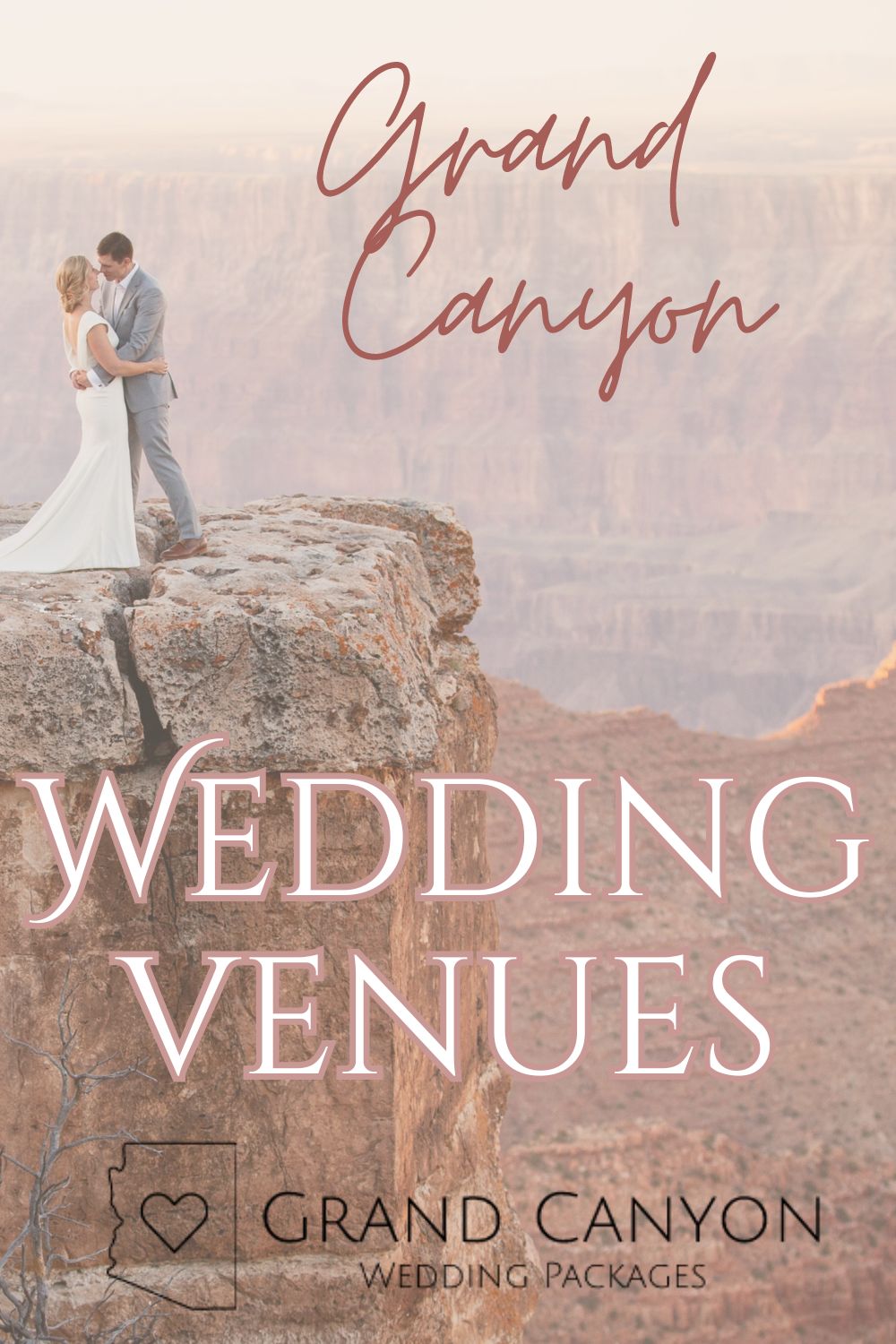
Pin Grand Canyon Wedding Venues

Grand Canyon Wedding Venues Graphic

Have You Picked a Favorite Grand Canyon Wedding Location? 

Just writing this article brought back so many memories of wonderful weddings we’ve helped plan at each location, and we can’t wait to start planning yours. Call or email us with any questions so we can find the perfect spot for your dream Grand Canyon wedding. 

Inside or Outside the Park? Grand Canyon Wedding Lodging

Watchtower Pool and Patio, Tusayan, Arizona, Squire Resort at the Grand Canyon

Planning a Grand Canyon destination wedding is exciting, and we can help you every step of the way. In this comprehensive guide, we’ll explore the best places to stay near the Grand Canyon for a wedding, ensuring your celebration is nothing short of spectacular.

Whether you want to stay in the park in one of the neighboring communities, we can help with any budget or amenities. Plus, we have some truly unique spots to show you in the high desert of Northern Arizona. 

Milky Way above a dome at Clear Sky Resorts, one of the Grand Canyon wedding lodging options
The Milky Way over a Sky Dome at Clear Sky Resorts Grand Canyon. (Photo Courtesy Clear Sky Resorts)

Grand Canyon Wedding Lodging Overview

With hundreds of lodging accommodations within 80 miles of Grand Canyon National Park, it helps to have an expert who not only knows the area but has also planned many weddings. 

One of the first questions we get asked about Grand Canyon Wedding lodging is, “How many nights should we stay?” We highly recommend staying at a Grand Canyon hotel for two nights – the night before and the night of your wedding. For those who can only stay one night, we suggest the night of the wedding instead of the night before. 

We can also use our experience with Grand Canyon weddings to find the perfect lodging, whether you want to have a romantic getaway for the couple and budget lodging for guests or want the whole group in one place. 

Our team also takes on the task of bargaining rates for larger groups, yet another way to avoid added stress on your to-do list. Let us know how many people you have in your group and how many rooms you need so that we can negotiate a tailored group rate. 

Grand Canyon Wedding Shoshone Point

The Top 5 Grand Canyon Wedding Lodging Locations

From inside the park to closer to the interstate, there are several wonderful communities to consider when you’re choosing the right place to stay for a Grand Canyon wedding. 

Inside Grand Canyon National Park

Our top Grand Canyon Wedding locations are on the South Rim of the Grand Canyon, which is close to several wonderful lodging options. Grand Canyon Village is the heartbeat of the South Rim, with four lodges in a row. The El Tovar is considered the pinnacle of national park hotels nationwide. 

Two other lodges are close to the village but more removed for those who want a little more space.  

El Tovar atop the South Rim of the Grand Canyon
El Tovar is the pinnacle of National Park hotels in the USA. (NPS Photo by Michael Quinn)
Bright Angel Lodge with snow on the ground at Grand Canyon National Park
Bright Angel Lodge on the South Rim of the Grand Canyon. (NPS Photo by Michael Quinn)

Tusayan

Tusayan is the closest community outside Grand Canyon National Park, just a few minutes from the south entrance. At the same time, guests are surrounded by the beauty of Kaibab National Forest. 

Enjoy local dining, shopping, and attractions that capture the spirit of the Southwest. Tusayan’s blend of comfort and proximity to the canyon ensures your wedding experience is both magical and hassle-free. 

  • Squire Resort at the Grand Canyon (Tusayan, Grand Canyon) Grand Canyon Weddings
  • Squire Resort at the Grand Canyon (Tusayan, Grand Canyon) Grand Canyon Weddings
  • Desert Lounge & Grill, Squire Resort at the Grand Canyon (Tusayan, Grand Canyon)
  • Squire Resort at the Grand Canyon (Tusayan, Grand Canyon) Grand Canyon Weddings
  • Squire Resort at the Grand Canyon (Tusayan, Grand Canyon) Jacuzzi tub, Grand Canyon weddings
  • Squire Resort at the Grand Canyon (Tusayan, Grand Canyon) Hotel room
  • Squire Resort at the Grand Canyon lobby (Tusayan, Grand Canyon)

Valle

Located about 30 miles south of the South Rim, Valle provides a quiet retreat away from the crowds. This scarcely developed area is home to two epic stargazing glamping sites, from luxurious tents to see-through domes. 

These luxury glamping sites come with all the amenities of a hotel – and then some – tucked under some of the most pristine skies in the United States. 

Tap photos to expand to full size


Williams

About an hour south of the Grand Canyon’s South Rim is the nostalgic town of Williams. As one of the original Route 66 stops, Williams still brings the Mother Road heyday vibe. Plus, this is where guests board the Grand Canyon Railway. 

Lodging here runs the gamut from remote rentals, railcars converted into rooms, and historic inns. 

  • Backland luxury camping williams arizona
  • Backland luxury camping williams arizona
  • Backland luxury camping williams arizona

Flagstaff

This is the largest community near the Grand Canyon and the closest to I-40. It is here that guests get the first glimpse of how different Northern Arizona is from the warmer desert portions of the state. 

While Flagstaff is at the intersection of countless things to do and places to see, it also offers impeccable overnight accommodation among the forest landscape at an elevation of 7,000 feet. Plus, it offers a scenic 75-mile drive to the Grand Canyon. 


Nearest Airports for a Grand Canyon Wedding

We recommend one of three airports, all offering year-round flights. Whether you prefer the closest airport or the one with the most flexible flight options, we put together this airport guide to help. 

Flagstaff Pulliam Airport (FLG)

The regional airport offers flights through American Airlines to Phoenix or Dallas (DFW). 

For ground transportation, it’s important to note that Flagstaff is about 75 miles from the Grand Canyon. Groome Transportation offers daily shuttle service to Williams and the Grand Canyon. We find that most clients prefer to rent a vehicle at the airport, with six companies to choose from with 24/7 access to vehicles. 

Should you prefer private transportation by town car, limousine, shuttle, or charter bus, let us know, and we will arrange that for you. 


Phoenix Sky Harbor International Airport (PHX)

The closest international airport to the Grand Canyon is Phoenix Sky Harbor International Airport, about 220 miles from the South Rim. Sky Harbor is an American Airlines hub, and Southwest and Frontier also have a strong presence. In total, two dozen airlines travel to and from the nation’s 12th busiest airport. 

Groome Transportation also offers a shuttle service from Phoenix. Call (928)350-8566 for questions about the shuttle and reservations. Private transportation like limos and charter buses can be arranged, but that gets expensive. 

Rental cars are the best option, and we find many of our clients prefer to take the 3-4 hour drive to the Grand Canyon at their own pace. Along the way, the drive includes exquisite views of the desert and a drive up the Mogollon Rim through several ecosystems. Between Phoenix and Flagstaff, the elevation increases by 6,000 feet. 


Harry Reid International Airport in Las Vegas (LAS)

Formerly known as McCarran International Airport, Harry Reid International Airport sees nearly 58 million passengers each year. Southwest Airlines is the dominant carrier at LAS, but the airport is also a hub for Allegiant Air, Frontier, JSX, and Spirit. In total, more than 30 airlines serve the airport between two terminals. 

While Las Vegas is 270 miles from the Grand Canyon’s South Rim, along the way, you’ll see Hoover Dam and Lake Mead National Recreation Area before connecting to I-40. Then, the drive includes 150 miles of diverse landscapes, from the arid desert surroundings of Kingman to the pine forests near Flagstaff. This route is also on the famous Route 66 Mother Road. 

Between Las Vegas and Flagstaff, you’ll gain 3,600 feet in elevation. Rental cars are readily available at LAS, and planning for private transportation can be arranged, but the price is certainly not budget-friendly. 


Map of Grand Canyon Wedding Lodging & Airport Locations


What You Should Know About Grand Canyon Helicopter Wedding Packages

Helicopter companies that promise Grand Canyon Wedding Packages to the Grand Canyon aren’t always 100% transparent, and we want to let you know the facts. 

Grand Canyon National Park, where the South Rim is located, doesn’t allow helicopters to fly or land below the rim. Even the airspace above the national park is heavily regulated for safety and to protect park resources. Flights from Las Vegas to “land in the Grand Canyon” will be at Grand Canyon West, which is on Hualapai Tribal Nation Land. 

Helicopter tours also depart from the Grand Canyon Airport in Tusayan for fly-overs of the national park. We are happy to help you plan a helicopter trip if you’d like. 

Grand Canyon West Helicopter
Helicopter tours of the Grand Canyon cannot land in Grand Canyon National Park and have restrictions on flying over the federally protected land. (Courtesy: Maverick Helictopers)

Plan Your Grand Canyon Wedding Today

Once you choose a home base for your Grand Canyon wedding accommodations, we can help you explore the options for add-ons, attractions, and adventures that await in Northern Arizona.

    Your First Name (required)

    Your Last Name (required)

    Your Email (required)

    Your Phone Number (required)

    Event Date

    If no specific date has been chosen, what is the general time frame you are planning for?

    Estimated Guest Count (required)

    Estimated Budget (required)

    Event Type (required)

    Package Type:

    Preferred Package:

    If a Custom Package is preferred, please tell us as much as you can about what you would like:

    How can we assist you: